
“Who am I? Where do I work? Who do I work with?”
When I introduce myself to others - particularly other teachers - I have a quick response that ‘defines’ me:
“I am Kate. I’m a teacher at Cashmere Primary School, and I teach Year 3 and 4 students.”
But that’s not the full picture. In truth I am lucky to teach among (and learn from) a diverse and multi-connected network of highly skilled teaching professionals.
Community of Practice?
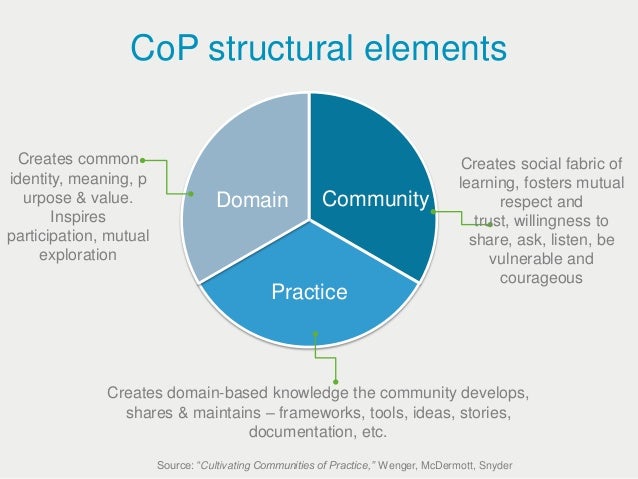
Wenger defines a ‘community of practice’ as “groups of people who share a concern or a passion or about a topic, and who deepen their knowledge and expertise in this area by interaction on an ongoing basis” (Wenger, McDermott & Snyder, 2002, p.4). There are three key elements that should be present when considering whether a group one belongs to truly is a ‘community of practice’:
-
Domain - joint enterprise (“collectively developed understanding);
-
Community - mutual engagement (regular interactions and trust);
-
Practice - shared repertoire (“communal resources”) (Wenger, 2000, p.229).
So with this in mind, I revisit the questions:
Who am I? What do I do? Who do I work with?
My communities of practice begin with the Cashmere Primary School teaching staff. In this group we work collectively towards increasing achievement and implementing the NZ Curriculum among our students.
I am a member of the Year 3 & 4 (Kōraho) collaborative team, and more flexible CoPs within that team for literacy, numeracy, and other curriculum areas. This is the CoP that I most strongly identify with, due to daily nature of our work, frequency of our interactions and close proximity to each other. We work together in an ILE, so it is crucial that we are a high-functioning CoP with strong mutual trust and respect for each other, and a shared understanding of what we are about. I am also working with two colleagues from the Kōraho team to complete the Mindlab postgrad course. The work we are doing in our Mindlab CoP is strengthening the critical reflection and research-based practice in our wider CoP.
As the Lead Teacher of Arts, I have also begun to meet regularly with the Lead Music Teachers from our local cluster of schools. We have begun to set some goals. As this is a new group, we are developing our relationships and mutual trust.
Online, I am a member of the Mindlab Google+ community, and a Facebook group of NZ Primary Teachers. I am becoming more confident in sharing my thinking, asking questions, and commenting on other people’s posts. I find support by reading the comments and posts of others.
How do I function within these groups?
Knox (2009) states that “you foster communities of practice, you don’t create them”. This statement speaks for my understanding of how connected I feel to these groups, and my sense of belonging. I feel more connected and feel most comfortable sharing ideas and questions in groups where my participation is more frequent, or where I have been part of the group for longer. It is in these groups that I find I interchange my role in the group, depending on the nature of the task or activity. I am an active member in these groups, sometimes I am the leader if I have expertise or skill that can be shared, or I follow and support others where necessary.
“Who am I? Where do I work? Who do I work with?”
Community of Practice?
Domain - joint enterprise (“collectively developed understanding);
Community - mutual engagement (regular interactions and trust);
Practice - shared repertoire (“communal resources”) (Wenger, 2000, p.229).
So with this in mind, I revisit the questions:
Who am I? What do I do? Who do I work with?
How do I function within these groups?
I have two further questions to ponder:
- Is there a CoP that I could give more energy to in order to feel more connected?
- Is there a ‘critical mass’ of CoPs that I can be an active member of beyond which quantity v. quality becomes unmanageable?
So… what now?
In conclusion, I am a member of a broad number of interconnected Communities of Practice, where I can find support, challenge assumptions and be challenged in return with others who have a shared understanding of our practice. My sense of connectedness and belonging in these CoPs is related to how much I foster my activity in these groups.
**This post was prepared as part of the requirements for CISC8100 Applied Practice in Context, for the fulfillment of requirements of a Post-Graduate Diploma in Applied Practice (Digital and Collaborative Learning) via Mindlab for UNITEC.
So… what now?
References
Knox, B. (2009, December 4).Cultivating Communities of Practice: Making Them Grow.. Retrieved from https://www.youtube.com/watch?v=lhMPRZnRFkk
Wenger, E.(2000). Communities of practice and social learning systems. Organization,7(2), 225-246.
Wenger, E., McDermott, R., & Snyder, W. (2002). Cultivating Communities of Practice: A Guide to Managing Knowledge. Cambridge, MA: Harvard Business School Press.
Comments
Post a Comment